

what is the cost of a hair transplant in Tijuana

Hair Transplant in Mexico – What You Need to Know Before You Book

If you’re losing your hair, you’re not just worried about your appearance. You’re thinking about confidence, aging, and how you show up in work, relationships, and daily life.

You’ve probably seen that hair transplant in Mexico can be dramatically more affordable than in the U.S. or Canada, and you might be wondering:

  • Is it safe?
  • Which technique (FUE, FUT, DHI) is best for me?
  • How much does it really cost?
  • What does the travel and recovery actually look like?

This guide is written from the perspective of a U.S.-based patient advocate who helps international patients plan hair transplant trips to Mexico. The goal is to give you a clear, practical overview so you can decide whether traveling for hair restoration makes sense for you.

In this article, you’ll learn:

  • Why many patients choose Mexico for hair transplant
  • The main techniques (FUE, FUT, DHI) and how they differ
  • What a typical trip and recovery timeline look like
  • Realistic cost ranges and how they compare to U.S. prices
  • How to choose a safe clinic and avoid “hair transplant factories”
  • How Health & Wellness Bazaar can coordinate your entire experience

Why Many Patients Choose Hair Transplant in Mexico

1. Significant Cost Savings vs. U.S. & Canada

In the U.S., hair transplant procedures often range from $8,000 to $15,000+, depending on the number of grafts and the clinic.

In Mexico, many reputable clinics charge roughly:

  • $2,000 to $6,000 for FUE or FUT, depending on technique, graft count, and clinic reputation

That averages out to savings of roughly 50–70% compared with U.S. prices—without automatically sacrificing quality, as long as you choose vetted surgeons and clinics.

2. Modern Techniques and Technology

Clinics in major Mexican hubs (such as Tijuana, Mexico City, Monterrey, Cancún) commonly offer:

  • FUE (Follicular Unit Extraction) – minimally invasive, small dot scars
  • FUT (Follicular Unit Transplant/Strip) – more traditional, linear scar, often cost-effective for large cases
  • DHI (Direct Hair Implantation) and other advanced FUE variations in select clinics

Many clinics use modern tools and techniques similar to what you’d find in top Western practices.

3. Convenience for U.S. and Canadian Patients

For patients in the U.S. and Canada, Mexico offers:

  • Shorter flights and easier travel planning
  • Familiar time zones
  • Bilingual staff used to working with international patients

For many, that combination—close, affordable, and modern—is what makes hair transplant in Mexico worth serious consideration.

Hair Transplant 101 – FUE, FUT, and DHI Explained

Before you pick a clinic, it helps to understand the basics of how modern hair transplants work.

FUE (Follicular Unit Extraction)

  • The surgeon removes individual follicular units (small groups of 1–4 hairs) from the donor area—usually the back or sides of the scalp—using tiny circular punches, typically around 0.8–1 mm in diameter.
  • These grafts are then implanted into the thinning or balding areas one by one.
  • Scars are small, dot-like, and usually not noticeable with short hair.
  • Recovery is generally faster and more comfortable compared to strip surgery (FUT).

Best for: Patients who prefer to wear shorter hairstyles, are concerned about visible scarring, or want a more gradual, natural-looking change.

Best for: Patients who prefer to wear shorter hairstyles, are concerned about visible scarring, or want a more gradual, natural-looking change.

FUT (Strip Method / Follicular Unit Transplant)

  • The surgeon removes a thin strip of scalp from the donor area (usually the back of the head), then the strip is dissected into individual follicular units under magnification.
  • The donor area is sutured or stapled, leaving a linear scar that can usually be hidden under longer hair.
  • The donor area is sutured or stapled, leaving a linear scar that can usually be hidden under longer hair.

Best for: Patients with more advanced hair loss who usually wear longer hair and want a large number of grafts in one session.

DHI and Other FUE Variants

Some clinics in Mexico now offer DHI (Direct Hair Implantation) and other advanced FUE-based methods:

  • Still uses FUE-style extraction
  • Uses specialized implanter tools that can help with angle, depth, and direction of placement
  • Often marketed as “no shave” or “minimal shave” for select patients

Best for: Highly selective cases where precision, density, or minimal shaving is a priority and budget allows.

Key Decisions Before Booking a Hair Transplant in Mexico

1. Your Long-Term Goal

Ask yourself:

  • Do you want a subtle improvement or a big change?
  • Is your main concern the hairline, crown, or both?
  • Are you okay with a linear scar (FUT) if it means more grafts for less money?

Your goal will influence which technique and how many grafts you need.

2. Graft Count and Donor Area Quality

Your surgeon will:

  • Examine your donor area (back and sides)
  • Estimate how many grafts can safely be harvested
  • Map out placement to match your age, face shape, and hair-loss pattern

Good surgeons plan not just for today, but for future hair loss—so you don’t end up with an unnatural island of hair later.

3. Surgeon and Clinic Selection

Look for:

  • A doctor with robust training in hair restoration (often dermatology or plastic surgery)
  • Membership in recognized hair restoration or plastic surgery societies
  • Clear before-and-after photos, especially with patients similar to you
  • Transparent explanations of technique, graft count, and expected density

Avoid:

  • Clinics that quote a price before reviewing photos or medical history
  • “Hair transplant factories” that emphasize volume over individualized planning
  • Teams where you can’t clearly identify who your surgeon actually is

4. Package and Logistics

For medical tourists, it’s usually smartest to choose a structured package that includes:

  • Procedure (FUE/FUT/DHI)
  • Clinic fees
  • Basic medications on-site
  • Hotel stay for a set number of nights
  • Airport–hotel–clinic transportation

This simplifies planning and helps you budget realistically.

What a Typical Hair Transplant Trip to Mexico Looks Like

This can vary by clinic, but here’s a common structure for international patients.

1. Before You Travel

  • Virtual consultation with your coordinator and/or surgeon
  • Photos of your scalp from multiple angles
  • Review of medical history, medications, and hair-loss pattern
  • Quote for the recommended technique, graft count, and package

2. Arrival Day

  • Fly into your chosen city (for example, San Diego for Tijuana)
  • Private transportation to your hotel or partner clinic
  • In-person consultation and final design of hairline and recipient areas

3. Procedure Day

  • Local anesthesia is used to numb the donor and recipient areas
  • For FUE, the procedure may take 4–8 hours, depending on graft count
  • For FUT, donor strip removal and closure happen first, then graft placement
  • You’re usually awake but relaxed, with breaks built in

You return to your hotel or recovery accommodation the same day, with detailed aftercare instructions.

4. First Few Days After Surgery

  • Mild discomfort, swelling, and tightness are common
  • Tiny scabs form around grafts
  • You’ll have instructions on how to sleep (head elevated), wash, and protect your scalp
  • Follow-up visit(s) to check grafts and donor area, remove sutures (if FUT), and answer questions

Most patients are cleared to fly home within a few days, based on their surgeon’s assessment.

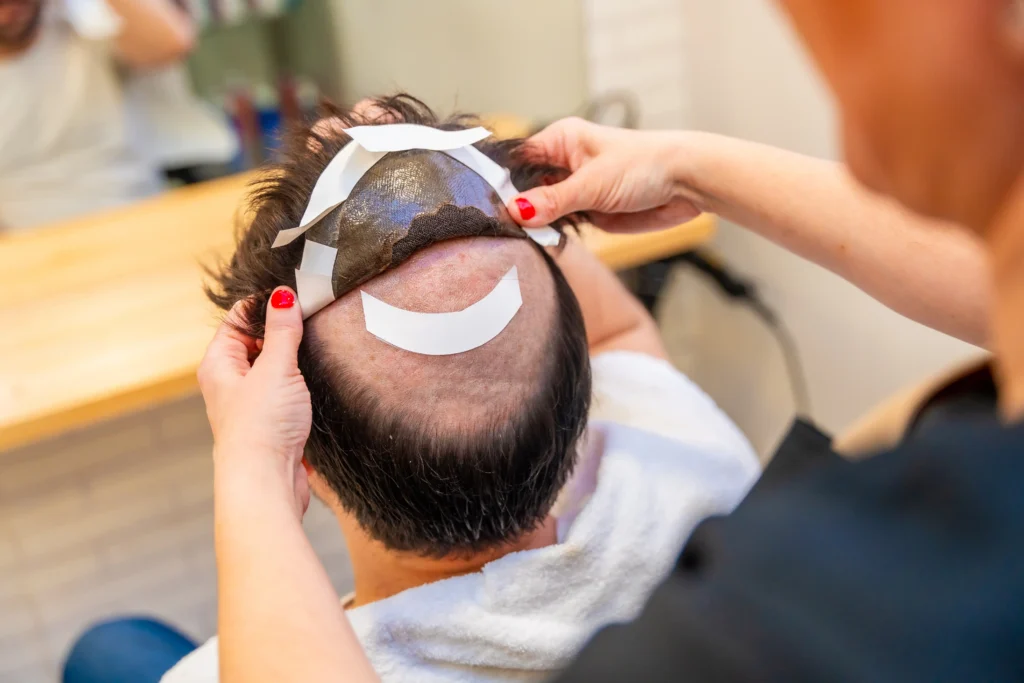
Surgeon performing a hair transplant procedure using precision tools for hair restoration.

Recovery & Hair Growth Timeline – What to Expect

Weeks 1–3: Healing and Shedding

  • Redness and scabbing gradually fade
  • Transplanted hairs often shed (this is normal “shock loss”)
  • Donor area improves; FUT patients have sutures/staples removed per protocol

Months 3–4: Early Growth

  • New hairs begin to grow in the transplanted areas, usually fine and thin at first
  • Density and texture can look uneven for a while—this is part of the process

Months 6–9: Noticeable Change

  • Hair becomes thicker and more pigmented
  • Density improves and styling options increase
  • Many patients start to feel more confident about their hairline and photos

Months 12–18: Final Result

  • Full results usually appear around 12 months, sometimes continuing to refine up to 18 months
  • At this point, transplanted hair behaves like your donor hair—grows, can be cut, colored, and styled normally

How Much Does a Hair Transplant in Mexico Cost?

Costs vary by:

  • Technique (FUE, FUT, DHI)
  • Number of grafts
  • Clinic reputation and city
  • Whether you choose a basic or all-inclusive package

Typical ranges:

  • Many clinics in Mexico charge around $2,000–$6,000 for hair transplant procedures, depending on technique and graft count.
  • Some FUE/FUT packages (procedure + hotel + transfers) fall in the $2,950–$5,500 range.

Compared to U.S. prices of $8,000–$15,000+, that represents savings of roughly 50–70% for many patients.

The key is to focus on quality and safety first, then look at price among vetted surgeons and clinics—not the other way around.

Is a Hair Transplant in Mexico Safe?

Hair transplant in Mexico can be very safe when:

  • You choose experienced surgeons and reputable clinics
  • The facility follows modern surgical and infection-control standards 
  • Anesthesia is handled by qualified professionals
  • You follow structured pre-op and post-op instructions

Where patients get into trouble is when:

  • They pick clinics purely based on being the cheapest
  • They don’t know who is actually performing the surgery
  • There’s little to no aftercare or follow-up support

This is exactly where a vetted network and coordinator matter.

Who Is a Good Candidate for Hair Transplant in Mexico?

You may be a good candidate if:

  • You have male or female pattern baldness with stable or predictable hair loss
  • You have a strong donor area on the back or sides of your scalp
  • You’re in generally good health and medically cleared for minor surgery
  • You understand that a transplant restores hair where follicles are placed—it doesn’t stop future loss in untreated areas

You may not be an ideal candidate if:

  • Your hair loss pattern is still very aggressive and rapidly changing
  • You have certain medical conditions or scalp diseases that limit graft survival
  • Your expectations are unrealistic (for example, wanting teenage density with limited donor hair)

An honest surgeon will tell you whether a transplant makes sense now, later, or not at all.

How Health & Wellness Bazaar Supports Hair Transplant Patients

At Health & Wellness Bazaar, our role is to be your patient advocate and coordinator for hair restoration in Mexico.

Vetted Hair Restoration Surgeons and Clinics

We work only with:

  • Surgeons experienced in FUE, FUT, and related techniques
  • Clinics that maintain modern standards for sterility, equipment, and anesthesia
  • Teams accustomed to working with international patients¸

All-Inclusive, Transparent Packages

Packages can be tailored to include:

You’ll receive a clear written quote so you can plan confidently.

Step-by-Step Support Before, During, and After Your Trip

Your dedicated coordinator will:

  • Review your photos and goals
  • Help you understand realistic outcomes and timelines
  • Guide you on what to pack, how long to stay, and when to fly
  • Facilitate communication with your surgeon during and after your trip

You’re not just booking a procedure—you’re gaining a support team.

FAQs – Hair Transplant in Mexico

How much does a hair transplant in Mexico cost?

Most reputable clinics in Mexico charge around $2,000–$6,000, depending on technique, graft count, and clinic reputation. Some all-inclusive packages fall in the $2,950–$5,500 range for common graft counts.

Which is better in Mexico – FUE or FUT?

Neither is “better” for everyone. FUE is popular for minimal scarring and quicker recovery, especially for patients who wear short hair. FUT can be more cost-effective for large graft counts but leaves a linear scar. The right choice depends on your hair-loss pattern, donor area, hairstyle preferences, and budget.

How long do I need to stay in Mexico after my hair transplant?

Many patients stay 3–5 days:

  • Day 1: arrival and in-person evaluation
  • Day 2: procedure
  • Days 3–4: post-op checks and early recovery
  • Day 4–5: flight home (as cleared by your surgeon)

Your exact stay will depend on your case and your surgeon’s protocol.

When will I see results from my hair transplant?

Expect:

  • Shedding of transplanted hairs in the first 2–8 weeks
  • Noticeable new growth starting around 3–4 months
  • Major improvement in density between 6–9 months
  • Final results around 12 months, with some refinement up to 18 months

Is it safe to get a hair transplant in Mexico?

It can be very safe when you choose:

  • Experienced surgeons
  • Reputable clinics with strong safety protocols
  • Structured packages and proper aftercare

Comparative analyses suggest that well-chosen Mexican clinics can have success rates in the 85–95% range, comparable to other leading medical tourism destinations.

Working through a vetted network like Health & Wellness Bazaar helps ensure you’re choosing from the safer, higher-quality end of the spectrum.

Ready to Explore Hair Transplant Options in Mexico?

Hair loss can feel discouraging—but you’re not stuck with it.

A well-planned hair transplant in Mexico can:

  • Restore your hairline and density
  • Be significantly more affordable than U.S. options
  • Give you a natural, long-term result when done safely and thoughtfully

With Health & Wellness Bazaar, you can:
  • Connect with vetted hair restoration surgeons in Mexico
  • Receive a transparent, all-inclusive quote based on your photos and goals
  • Get step-by-step support from your first message to your final follow-up

Similar Posts